
 Written by Gordon Meredith
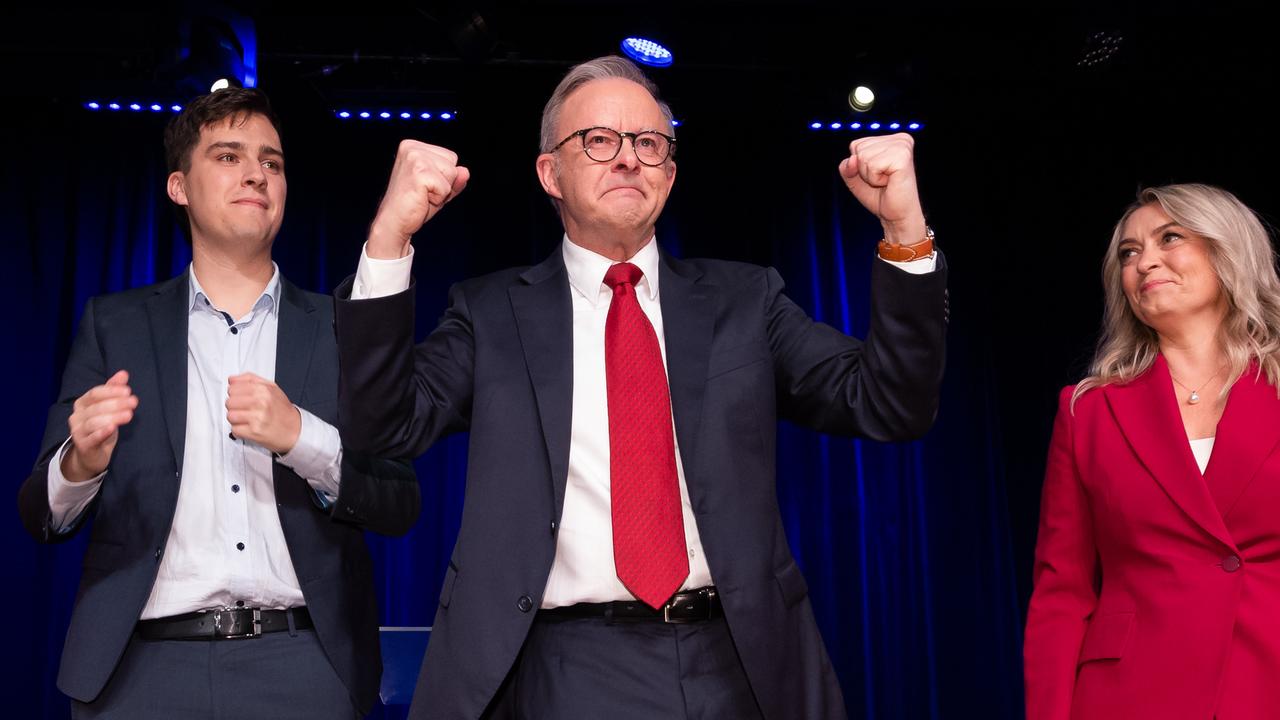
Anthony Albanese became Australia’s first Prime Minister since John Howard in 2004 to be returned to office following an election on Saturday night, and the first Labor leader to do so since the 1980s.
Labor has won at least 85 seats, (and as of the time of writing are leading in a further 9 seats) while the Coalition has so far secured 39 with 16 seats across the Parliament still in doubt.

Credit: Anthony Green, ABC
Voting Trends:
While the two-party preferred result of 55%-45% is the best for Labor since the end of World War Two, and shows a 2.8% swing to the ALP, the overall vote of the two major parties continues to decline as the primary vote for independents and minority parties rise. The combined vote for the minor parties and independents has now overtaken the Coalition, at just over one third of the primary vote.

Credit: Anthony Green, ABC
The ‘teal’ independents look to retain the majority of their seats (Zoe Daniel in Goldstein, and Monique Ryan in Kooyong are still too close to call) despite concerns about their electorates reverting to Liberal Party candidates. This voting pattern suggests that inner-suburban voters still have climate change, gender equality and integrity in government at the top of their priority list, even during a cost-of-living crisis.
The same cannot be said for the Greens, however, who were at risk of losing all representation in the lower house (the Greens are leading in Ryan, while Adam Bandt’s seat of Melbourne in undergoing a re-throw of preference counting) despite maintaining their national primary vote count at around 12%. While the swings in Melbourne and Brisbane are clear, in several Greens seats, their defeat did not primarily come due to a dropping primary vote but the increased Labor vote pushing the LNP into third, and in turn the LNP preferences flowing to Labor.
The Liberal National Party coalition now finds itself at a crossroads, and in need of a new leader after Peter Dutton lost his seat of Dickson. Sussan Ley, Angus Taylor and Dan Tehan have been touted as the most likely candidates with Andrew Hastie and Jane Hume also mentioned in dispatches. A proper leadership tilt will take some time to land.

The leadership race for the Liberal Party is wide open.
While Shadow front bencher Bridgit McKenzie today left the door open for the LNP’s contentious “nuclear energy policy” it will likely be abandoned as part of a detailed review of all the Coalition’s policies. This will be tricky for two reasons: first, the Liberal Party lost in the suburbs but the Nationals consolidated their seats, giving that side of Coalition an increased presence on the Shadow front bench. Second, there are currently no leadership contenders from Queensland, which will compound the Coalition’s devastating result in that state.
While the election campaign was littered with Trumpian influence and comparisons, Clive Palmer’s Trumpet of Patriots failed to secure any lower house seats despite massive spending on advertising (and a barrage of unsolicited text messages) with the party landing just 1.85% of the primary vote.
The Senate Picture
With the ALP growing its majority in the House of Representatives, legislative outcomes will be determined by the Senate’s continued shift to the left after senators elected in 2019 came up for re-election.
Despite their Lower House disappointment, the Greens are projected to maintain their 11 Senate seats, maintaining representation in each state for the third successive election, and with it the presumptive ‘balance of power.’
Progressive independent David Pocock recorded an impressive count in the Australian Capital Territory, almost doubling his share of the vote to 42.0% on current figures.

Credit: Guardian / ABC
Labor is set to gain a seat from the Coalition in Queensland, restoring left-right balance to that state after a 2019 result of three seats for the Coalition and one each for Labor, the Greens and One Nation.
Each of the other states could also tilt the balance of the chamber a seat further to the left by returning three Labor senators in addition to one for the Greens, although this is only rated as “likely” in New South Wales and South Australia.
Combined, these results suggest a strong chance that Labor and the Greens will account for a majority of 39 seats out of 76. If independents David Pocock, Fatima Payman and Lidia Thorpe are also included, the senate is projected to have a “progressive bloc” compromised of 42 seats out of 76.
Governance Expectations
While political parties are usually emboldened by landslide victories, Prime Minister Albanese’s first term was characterised by due process and procedure, and there is nothing to indicate that his second term will be any different.

Prime Minister Albanese returned to Parliament on Monday.
Speaking in the Parliament House courtyard today, Albanese committed to leading a “disciplined, orderly government” while reassuring the public that his first port of call would be introducing a bill to cut student debt by 20%.
Treasurer Jim Chalmers was equally as stoic in victory, explaining that Labor’s focus in its first term was “primarily inflation without forgetting productivity” and his Treasury’s second term will be “primarily productivity without forgetting inflation.”
While more is often expected of re-elected governments, expect Labor’s policy developments to be iterative, rather than revolutionary, such are Albanese’s considerations for insuring that his brings a vast majority of the Australian public along for the progressive policy ride.
The Prime Minister also promised stability during the election campaign and as such he is yet to name a date to announce caucus as key election contests remain in doubt. That being said, more than a dozen new MPs – including a raft of new women – will change the factional structure and makeup of the new ministry.
If your organisation would like assistance in how best to communicate with the new government, please reach out to us.